The Provenance Problem: Why the Story Behind Your Clothes Is the New Status Symbol
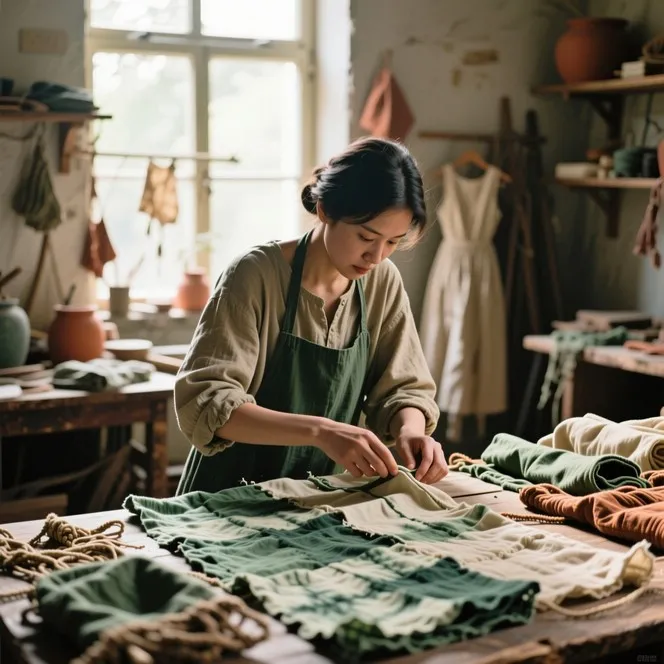
Photo: artisan craftsperson handmade sustainable fashion textile workshop, via images.stockcake.com
There's a jacket hanging in my closet that I can tell you almost nothing about. I know the brand name. I know roughly what I paid for it. I know it was made somewhere in Southeast Asia, because the tag says so. That's it. That's the whole story.
I bought it five years ago because it looked good and the price felt reasonable. At the time, that seemed like enough information to make a decision. Increasingly, it doesn't.
Something has shifted in the way a growing number of Americans — especially younger ones — think about the things they choose to wear. The question has moved from does this look right? to does this feel right to own? And answering that second question requires a lot more information than a brand name and a care label.
What Transparency Actually Means (And What It Doesn't)
The word "transparency" gets thrown around a lot in fashion right now, and like most buzzwords, it's been stretched to cover a pretty wide range of things — some meaningful, some not.
A brand posting a vague commitment to "sustainable practices" on its website is not transparency. A company claiming its products are "ethically made" without specifying what that means is not transparency. These are gestures in the direction of accountability without actually delivering it.
Real transparency looks different. It means being specific about where materials are sourced and from whom. It means naming the people involved in production — not just the country, but the actual workshop, cooperative, or individual craftsperson. It means explaining why certain materials or methods were chosen, not just that they were. And it means being honest about the limitations and trade-offs involved in the process, because there are always trade-offs.
This kind of specificity is harder to fake. And that's exactly why it's becoming the new benchmark for discerning buyers.
A Checklist for Evaluating Authenticity Claims
If you're trying to figure out whether a brand's sustainability story is genuine or just well-produced marketing copy, here are some concrete questions worth asking:
Can they name their makers? Not just the country of origin, but the actual facility, cooperative, or artisan. Brands with genuine relationships with their producers are usually proud to name them.
Do they explain their material choices? Anyone can say they use "natural fibers" or "sustainable materials." What you want to know is why they chose a specific supplier, what the certification status of those materials is, and what the alternative would have been.
Is the production process described in real detail? Vague language like "handcrafted with care" is a red flag. Genuine artisanal producers tend to go deep on process because they're proud of it — they'll tell you about dye methods, finishing techniques, the number of hours a specific piece takes to complete.
Do they acknowledge imperfection? Mass-produced goods are uniform. Handmade goods aren't. Brands that lean into variation — that tell you each piece will look slightly different — are usually telling the truth about how things are made.
Is pricing consistent with the story? A garment described as entirely hand-stitched by a skilled artisan, sold for $35, should raise some questions. Authentic artisanal production costs money. If the price doesn't reflect that, something in the story isn't adding up.
Does the brand talk about trade-offs? Honest producers acknowledge that their methods aren't perfect. They might explain why they haven't achieved full supply chain visibility yet, or why they use a particular synthetic component despite preferring not to. That kind of candor is a good sign.
Voices From the Studio: AF Originals Artisans on Their Process
At AF Originals, transparency isn't a marketing strategy — it's baked into the model. The platform is built around creators who are willing to document and share the full arc of their process, from raw material to finished piece.
We asked a few of the artisans in the AF Originals community to describe what that looks like in practice.
"Every bolt of fabric I use comes from a small mill in North Carolina that I've visited in person. I know the owner. I know how the looms work. When a customer buys something from me, I can tell them exactly where the material started — and I do. It's part of every product description I write." — textile designer based in Asheville, NC
"I use natural dyes almost exclusively, which means my colors are never perfectly uniform and they shift a little over time with washing and light. I used to worry that would put people off. Now I lead with it. The customers who get it really get it — they're buying something that's going to age with them, not fall apart." — fiber artist and garment maker based in Taos, NM
"People ask me why my pieces cost what they do. I tell them: this took me 14 hours to make. Here's what that math looks like. Most of the time, they don't push back — they just hadn't been shown that math before." — hand-embroidery specialist based in Chicago, IL
That last point matters. Consumers aren't generally opposed to paying fair prices for things that are genuinely worth it. What they resist is paying premium prices for things that turn out not to be. The more clearly a maker can show their work — literally and figuratively — the more that trust gets built.
Gen Z and the Ownership of Meaning
If you want to understand why provenance has become such a powerful driver of purchasing decisions, it helps to look at the generation that's most aggressively pushing the conversation.
Gen Z shoppers, broadly speaking, have grown up in an environment saturated with brand messaging. They're not naive about it. They've watched too many corporate social media accounts perform progressive values while their parent companies do something entirely different. That experience has produced a generation with a finely tuned skepticism detector.
What actually earns their trust isn't bigger claims — it's smaller ones. More specific ones. A brand that can tell them the name of the person who wove the fabric in their shirt is doing something that a multinational corporation structurally cannot do. That specificity is the point.
There's also something deeper going on around identity. For a lot of Gen Z consumers, what you wear is a statement about what you value — not just aesthetically, but ethically and politically. Wearing a piece with a documented, honest story is a way of making that statement visible. It's not about showing off; it's about alignment. The garment becomes a kind of artifact of the values you're trying to live by.
That's precisely what the AF Originals brand ethos — Wear the Art. Own the Story. — is speaking to. The story isn't an add-on. It's the product.
The Long Game
Fashion has always been about aspiration. What's changing is what people are aspiring toward.
For a long time, the aspiration was access — to a name, a logo, a cultural signal that said you'd arrived somewhere. That still exists, and it probably always will. But alongside it, a different kind of aspiration is growing: the desire to own things that are genuinely worth owning. Things made with skill, intention, and honesty. Things that come with a story you can actually tell.
That's not a niche preference anymore. It's a direction the market is moving, driven by consumers who've had enough of the alternative.
The brands that figure out how to meet that moment — not by performing transparency, but by actually practicing it — are the ones that will still be around in twenty years. The pieces they make will still be in closets, wearing better with age, their stories still intact.